


Bowling ball performance and resulting ball life By Nick Siefers, USBC research engineer
05/23/07
Lesson 3
Courtesy of USBC Equipment Specification and Certification
My previous two articles explored the core properties and relationship between the core and cover stock (or shell) of a bowling ball.
Basic terminology such as "radius of gyration" and "differential radius of gyration" were covered along with different types of cover stocks on the market today. Finally, integrating the core to match a particular cover to generate a desired ball reaction, and a major concept relating to oil absorption, were also covered.
Taking this a step further, some may ask about the overall ball performance of the selected core and cover as it relates to the "ball life."
In this article, we will derive bowling ball performance from a microscopic and macroscopic analysis, which will lead into the discussion of the resulting ball life and different techniques to ultimately prolong the life of a bowling ball.
As explained previously, a bowling ball's ability to absorb oil is crucial to ball performance. This is becoming a trend in the USBC Ball Motion Study. It is this ability, along with track flare, that allows a ball's surface to remain in a "dry" state as the ball travels down lane.
Due to a dry surface contacting the lane, increased friction and, therefore, increased hook is expected compared to a ball that does not absorb oil or flare well.
The questions then become: "Where does the oil go once absorbed into the ball?" and "Does this oil absorption concept alter bowling ball reaction?"
One must not make the assumption, however, that oil absorption is the only factor in a ball's performance and reaction. Pro shop operators and bowlers know that the different shell chemistry (plastic, urethane, reactive urethane and particle), surface roughness and the amount of flare potential affect reaction on the lane.
Also, it is known that typically, as technology continues to advance and as new balls become available, an increase in performance, hook and friction is usually the result. The remainder of this discussion will keep these factors in mind but concentrate on the oil absorption principle.
One possible way that a new shell is engineered, researched and analyzed is to tie the research to science and look at concepts from a microscopic and macroscopic point of view.
In a lab setting, a chemical formula and model can be built to describe and help predict lane performance. There are different technologies used to determine the polymer structure, roughness and porosity of an experimental shell.
Two such lab technologies that are capable of this analysis are as follows:
1) Atomic Force Microscopy (AFM)
2) Mercury Intrusion Porosimetry (MIP)
The AFM, a very high-resolution type of scanning probe microscope with demonstrated resolution of fractions of a nanometer, provides a true three-dimensional surface profile. This can help the user see the porosity in the sample being analyzed.
In the MIP method, mercury is forced to penetrate into porous samples under stringently controlled pressures. Pressure measurements taken provide data on the volume, size of the pores and the density of the cured composite.
These microscopic lab techniques are useful because they allow an analysis of a small sample of a developing cover stock to be conducted without the extra expense of producing an entire ball.
It is worth noting that at USBC, a similar technology is being used to analyze the cover stocks of bowling balls. Our Fourier Transform Infrared Spectrometer analyzes the chemical composition of the shells by matching the reflectivity of a sample's wavelength of light to specific industry standards per polymer in the shell.
This type of analysis allows the USBC research team to determine the latest materials that are being used by bowling ball manufacturers in the production of cover stocks. The results aid in the investigation of how bowling ball cover stocks affect lane surfaces, oil patterns and overall ball motion.
Progressing from a microscopic view, a macroscopic view of new cover stock samples can be physically tested with lane oil to ensure absorbance is occurring. In this case study of one particular type of urethane/reactive urethane, Figures 1 and 2 are graphs showing the mass results of submerging samples of urethane (non-porous elastomer) and a reactive urethane (porous elastomer) in a quantifiable amount of lane oil.
Click on an image to see it full size.
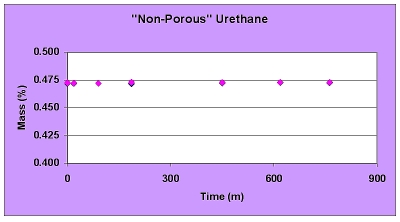
Figure 1: Non-Porous Elastomer (Urethane).
As shown in Figure 1, the non-porous urethane sample does not absorb oil very well over a period of time. This can be seen by taking the mass of the sample at certain time intervals. The mass stays relatively constant.
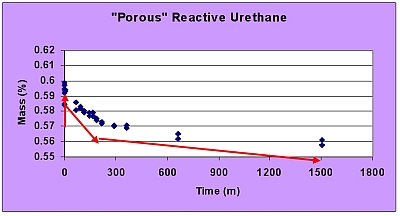
Figure 2: Porous Elastomer (Reactive Urethane)
However, in Figure 2, an interesting trend is evident. During the first minutes of testing, the porous elastomer shows an increase in mass when submerged in lane oil, but after a certain amount of time, the sample mass begins to decrease.
A chemical analysis explains this phenomenon. As discussed in previous articles, a reactive urethane is a urethane base with extra "reactive material" added to create the porosity that allows the shell to absorb oil. This extra reactive material is less dense than lane oil. Due to the density difference between the two chemicals, the reactive material will rise and rest above/on top of the lane oil.
For example, think of water and ice. Ice is very porous and less dense than liquid water. This explains why ice floats. The more dense water settles beneath the ice.
Thus, in this lab example, lane oil initially fills the voids created by the reactive urethane shell, which can be seen as a mass increase.
As the oil is absorbed, it encounters and displaces additional, less dense reactive material. The reactive material will then migrate out of the pores, resulting in a mass decrease.
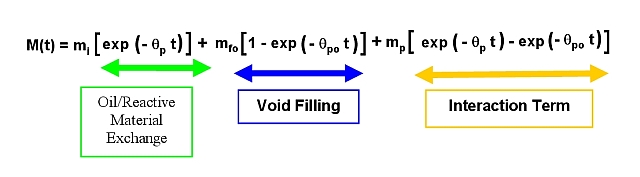
Below is a kinetic mathematical model containing mass and rate constants that relate the mass (M) of the sample to the oil absorption and excess "reactive material" exchange.
As new technology is released and increased hook/friction is experienced with leaps in cover stock technology, the questions raised in the introduction become more prevalent. There are two basic factors that influence bowling ball life: surface wear and oil absorption.
Surface wear is simply the "tracking out" of a ball as it is used in competition and can be seen on a ball surface. This change in surface roughness can alter overall ball motion.
With oil absorption, however, the performance loss is only noticed by a decrease in the amount of hook.
This performance loss due to oil can be explained practically. For instance, think of a bowling ball as an ordinary sponge. As with a sponge, once the large pores are filled with water, the sponge cannot absorb any more water until it is rung out.
The bowling ball acts in a similar manner, although the pores are microscopic as discussed earlier. Once the ball's pores are filled to capacity, the bowling ball will not be able to absorb any more lane oil.
Without the capability to absorb lane oil, a reactive ball will lose its ability to hook because the lane oil will stay on the ball's surface, acting as a lubricant. Therefore, a bowler will notice a loss in overall ball performance or hook.
Below in Figure 3, the ball path of a control-fresh out of box reactive ball is thrown against the same type of test ball with 100 games on it. Using C.A.T.S data, a decrease in friction and total hook is experienced with the used ball. Therefore, the case can be made that oil absorption initially improves ball reaction but long term oil absorption hurts performance.
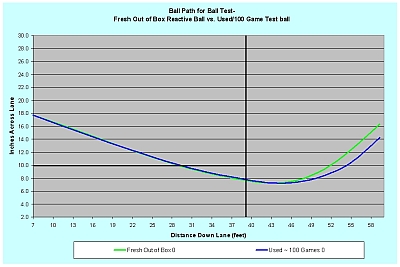
Figure 3: Fresh Out of Box vs. Used (100 Games)
The next question usually asked is how can bowlers restore the lost hook from a bowling ball.
The answer is straightforward: a used bowling ball will not have 100 percent of the reaction it had as a fresh ball.
However, manufacturers have taken steps both in the research of new shells and marketable products to help recover some of the lost reaction. Hook Again®, CPR®, Revivor® and a Rejuvenator Oven® are a few examples of products currently on the market to help restore ball performance.
Of course, a standard resurfacing at a local pro shop will help restore performance lost due to surface wear.
In conclusion, the vast amount of information covered above will hopefully provide a better understanding of how shell chemistry and oil absorption relate to the life of a bowling ball. It is important to realize that the chemical composition of the shell can be analyzed using both a microscopic and macroscopic viewpoint.
It is the mathematical models and analysis results that lead to a better understanding of overall bowling ball motion over time.
Editor's note: Nick Siefers earned a BS degree in Chemical Engineering from Purdue University. He can be reached at Nick.Siefers@bowl.com.
Basic terminology such as "radius of gyration" and "differential radius of gyration" were covered along with different types of cover stocks on the market today. Finally, integrating the core to match a particular cover to generate a desired ball reaction, and a major concept relating to oil absorption, were also covered.
Taking this a step further, some may ask about the overall ball performance of the selected core and cover as it relates to the "ball life."
In this article, we will derive bowling ball performance from a microscopic and macroscopic analysis, which will lead into the discussion of the resulting ball life and different techniques to ultimately prolong the life of a bowling ball.
As explained previously, a bowling ball's ability to absorb oil is crucial to ball performance. This is becoming a trend in the USBC Ball Motion Study. It is this ability, along with track flare, that allows a ball's surface to remain in a "dry" state as the ball travels down lane.
Due to a dry surface contacting the lane, increased friction and, therefore, increased hook is expected compared to a ball that does not absorb oil or flare well.
The questions then become: "Where does the oil go once absorbed into the ball?" and "Does this oil absorption concept alter bowling ball reaction?"
One must not make the assumption, however, that oil absorption is the only factor in a ball's performance and reaction. Pro shop operators and bowlers know that the different shell chemistry (plastic, urethane, reactive urethane and particle), surface roughness and the amount of flare potential affect reaction on the lane.
Also, it is known that typically, as technology continues to advance and as new balls become available, an increase in performance, hook and friction is usually the result. The remainder of this discussion will keep these factors in mind but concentrate on the oil absorption principle.
One possible way that a new shell is engineered, researched and analyzed is to tie the research to science and look at concepts from a microscopic and macroscopic point of view.
In a lab setting, a chemical formula and model can be built to describe and help predict lane performance. There are different technologies used to determine the polymer structure, roughness and porosity of an experimental shell.
Two such lab technologies that are capable of this analysis are as follows:
1) Atomic Force Microscopy (AFM)
2) Mercury Intrusion Porosimetry (MIP)
The AFM, a very high-resolution type of scanning probe microscope with demonstrated resolution of fractions of a nanometer, provides a true three-dimensional surface profile. This can help the user see the porosity in the sample being analyzed.
In the MIP method, mercury is forced to penetrate into porous samples under stringently controlled pressures. Pressure measurements taken provide data on the volume, size of the pores and the density of the cured composite.
These microscopic lab techniques are useful because they allow an analysis of a small sample of a developing cover stock to be conducted without the extra expense of producing an entire ball.
It is worth noting that at USBC, a similar technology is being used to analyze the cover stocks of bowling balls. Our Fourier Transform Infrared Spectrometer analyzes the chemical composition of the shells by matching the reflectivity of a sample's wavelength of light to specific industry standards per polymer in the shell.
This type of analysis allows the USBC research team to determine the latest materials that are being used by bowling ball manufacturers in the production of cover stocks. The results aid in the investigation of how bowling ball cover stocks affect lane surfaces, oil patterns and overall ball motion.
Progressing from a microscopic view, a macroscopic view of new cover stock samples can be physically tested with lane oil to ensure absorbance is occurring. In this case study of one particular type of urethane/reactive urethane, Figures 1 and 2 are graphs showing the mass results of submerging samples of urethane (non-porous elastomer) and a reactive urethane (porous elastomer) in a quantifiable amount of lane oil.
Click on an image to see it full size.

Figure 1: Non-Porous Elastomer (Urethane).
As shown in Figure 1, the non-porous urethane sample does not absorb oil very well over a period of time. This can be seen by taking the mass of the sample at certain time intervals. The mass stays relatively constant.

Figure 2: Porous Elastomer (Reactive Urethane)
However, in Figure 2, an interesting trend is evident. During the first minutes of testing, the porous elastomer shows an increase in mass when submerged in lane oil, but after a certain amount of time, the sample mass begins to decrease.
A chemical analysis explains this phenomenon. As discussed in previous articles, a reactive urethane is a urethane base with extra "reactive material" added to create the porosity that allows the shell to absorb oil. This extra reactive material is less dense than lane oil. Due to the density difference between the two chemicals, the reactive material will rise and rest above/on top of the lane oil.
For example, think of water and ice. Ice is very porous and less dense than liquid water. This explains why ice floats. The more dense water settles beneath the ice.
Thus, in this lab example, lane oil initially fills the voids created by the reactive urethane shell, which can be seen as a mass increase.
As the oil is absorbed, it encounters and displaces additional, less dense reactive material. The reactive material will then migrate out of the pores, resulting in a mass decrease.
Below is a kinetic mathematical model containing mass and rate constants that relate the mass (M) of the sample to the oil absorption and excess "reactive material" exchange.

As new technology is released and increased hook/friction is experienced with leaps in cover stock technology, the questions raised in the introduction become more prevalent. There are two basic factors that influence bowling ball life: surface wear and oil absorption.
Surface wear is simply the "tracking out" of a ball as it is used in competition and can be seen on a ball surface. This change in surface roughness can alter overall ball motion.
With oil absorption, however, the performance loss is only noticed by a decrease in the amount of hook.
This performance loss due to oil can be explained practically. For instance, think of a bowling ball as an ordinary sponge. As with a sponge, once the large pores are filled with water, the sponge cannot absorb any more water until it is rung out.
The bowling ball acts in a similar manner, although the pores are microscopic as discussed earlier. Once the ball's pores are filled to capacity, the bowling ball will not be able to absorb any more lane oil.
Without the capability to absorb lane oil, a reactive ball will lose its ability to hook because the lane oil will stay on the ball's surface, acting as a lubricant. Therefore, a bowler will notice a loss in overall ball performance or hook.
Below in Figure 3, the ball path of a control-fresh out of box reactive ball is thrown against the same type of test ball with 100 games on it. Using C.A.T.S data, a decrease in friction and total hook is experienced with the used ball. Therefore, the case can be made that oil absorption initially improves ball reaction but long term oil absorption hurts performance.

Figure 3: Fresh Out of Box vs. Used (100 Games)
The next question usually asked is how can bowlers restore the lost hook from a bowling ball.
The answer is straightforward: a used bowling ball will not have 100 percent of the reaction it had as a fresh ball.
However, manufacturers have taken steps both in the research of new shells and marketable products to help recover some of the lost reaction. Hook Again®, CPR®, Revivor® and a Rejuvenator Oven® are a few examples of products currently on the market to help restore ball performance.
Of course, a standard resurfacing at a local pro shop will help restore performance lost due to surface wear.
In conclusion, the vast amount of information covered above will hopefully provide a better understanding of how shell chemistry and oil absorption relate to the life of a bowling ball. It is important to realize that the chemical composition of the shell can be analyzed using both a microscopic and macroscopic viewpoint.
It is the mathematical models and analysis results that lead to a better understanding of overall bowling ball motion over time.
Editor's note: Nick Siefers earned a BS degree in Chemical Engineering from Purdue University. He can be reached at Nick.Siefers@bowl.com.