


Could following the lead of other youth sports be the key to growing bowling? By Mark Miller
06/03/11
 As part of a family that had owned Rose City Bowl in New Castle, Ind., for more than 40 years, he had seen the number of bowlers in his area and nationwide dip for a long time. After so many ideas failed to change that, he was scratching his head.
"I wanted to know what I could do to reverse the trend," Rutherford said. "Turned out I was in the right place at the right time."
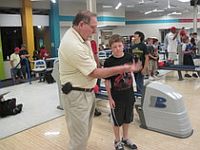
Pictured left: Coach Bill Lish helps a youth bowler during action at Lakes Lanes in The Colony, Texas.
That place was the East Coast Bowling Centers Convention last October in Atlantic City, N.J. That's where he heard a new idea from then-Bowling Proprietors' Association of America Director of Youth Development Chad Murphy.
The idea – mimic the successful youth programs of soccer and baseball which emphasize coaches for every team, practice sessions before starting competition, payment up front and commitment of only 8-10 weeks. Plus, they had fun while developing team unity.
"I heard it again at the BPAA Board meeting and it finally sunk in the second time," Rutherford said. "You have to treat your Saturday morning youth program like other sports.
"For years we've said to kids 'you can go here and there to play other sports during bowling. You can just pre-bowl. If you're no good, it doesn't matter because we'll give you handicap.'
"There is not another sport where you show up and the other team says, 'you are short and we're tall so we'll give you a handicap.' Like in basketball 'you take your shots under the basket and we'll take ours at the free-throw line.' In baseball, 'you get an extra out or four strikes because you are not as good.' "
So Rutherford told his youth to choose between bowling and other sports during bowling season. And he agreed to heed Murphy's request to test the new concept with some initial reservations.
"Eliminating handicap is a radical idea," Rutherford admitted. "That's like saying grandma wears army boots. That's almost un-American."
Other challenges included not having enough trained volunteer coaches, finding new bowlers or setting practice times. But the test centers all were willing to try the concept.
"Everyone tends to be reluctant to change especially when you've done things for years," said Georgia Wiggins, director of youth development at West Acres Bowl in Wichita, Kan.
West Acres has conducted tests both last fall and this spring. The 10-week program broke down to three Saturdays of coaching and practice followed by six weeks of competition and one day for awards.
"I like the short season format for parents and kids because it gives them a break like other sports," Wiggins said. "The parents really like the coaching. We had one coach per team in the fall and two per team this session. That includes some current Wichita State and Newman University players and Wichita State alumni."
In most tests, youth bowl a combination of regular team games and Baker format where players alternate turns within the same game.
At Fox Bowl in Wheaton, Ill., Kim Sims incorporated the test into a curriculum she wrote to transition youth from In-School bowling to the lanes. She offered five weeks of coaching/practice and five weeks of competition for the 17 bowlers who participated in January and February.
"This program emphasizes instruction so we're not just throwing the kids on the lanes," Sims said. "In some places, the youth bowling program is a baby-sitting service."
Fox Bowl employees served as the team coaches and like West Acres, included a bowling ball with the program. Sims is a big fan.
"This new program is wonderful because of the new emphasis on coaching," she said. "It's attractive to those who want to improve."
Sims sees the new program as something that's ultimately added to, not replacing, current youth programs.
"I think the traditional youth league will be more for people in club sports who are seeking scholarships," Sims said. "For people who don't want to or can't make the commitment, the new program is best.
"This is part of the changing times. We understand we have a new generation of kids so you have to offer a lot of options."
So exactly how did BPAA, and specifically Murphy, now director of youth development for the International Bowling Campus, come up with the new option?
"The whole thing came from me watching my son (Joshua) playing other sports," said Murphy, a former collegiate bowler and certified coach who worked for Ebonite International and Columbia 300 prior to BPAA. "They emphasized skill instruction, fun and the social element."
It was in October 2009 that Murphy told then United States Bowling Congress Director of Youth and old friend Brian Graham his idea. Graham invited Murphy to join a committee that was looking into growing youth bowling. After the committee met in November and January 2010, BPAA was impressed enough to hire Murphy last April.
By August, he put together a plan based on the success of the other sports.
"We had to appeal to the non-bowlers," Murphy said. "Bowling has historically been passed down from grandfather to son to grandson and the same for the ladies. But that was when we had nine million bowlers. We skipped two generations."
Still, surveys said there a large potential audience to change that.
"There are 20 million youth under age 18 who bowl at least once a year," Murphy said. "That's it in a nutshell. Bowling is the No. 1 destination for birthday parties. We needed to figure out how we get them to bowl for a lifetime. We needed to give them a format they were familiar with and incorporate it to bowling."
While the new BPAA and USBC leadership liked Murphy's plan, there initially was no way to pay it. That's when the idea for the Youth Education Services Fund started.
The YES Fund started when Brunswick, Columbia 300, Ebonite, 900 Global, Hammer, QubicaAMF, Roto Grip, Storm and Track agreed to contribute a combined $250,000. Other companies joined later.
"The stumbling block, if any, is that youth bowling always has been on a long schedule," Murphy said. "This is where we needed to get them in, hopefully excited and committed and eventually bowling in longer leagues."
The program aims to start with youth at age 8.
"Kids physically struggle to play our game until they are 8 or 9 because of the weight of the ball," Murphy said. "Our lowest weight ball is six pounds which based on 10 pounds per year means the kid would need to be at least 60 pounds to use it. That's one of the barriers we have but we can get past that."
With funding in place, the next step was to secure the initial test centers last fall. More centers were added for Phase 2 tests early in 2011 with more than two dozen on board by March.
"We didn't have any new kids so we took eight from our existing leagues," said Debbie Haggerty, youth coordinator at Fireside Lanes in Sacramento, Calif. "When they were done we were extremely pleased with the outcome. They liked the team aspect, Baker format and skill drills. Their improvement was amazing."
The test centers reported their findings in April then refined the program in time to launch it nationally at Bowl Expo. Rutherford will be there to sing its praises.
"No matter how many show up, nobody can tell me this will not be the way we're going to grow," Rutherford said. "I just hope other proprietors around the country get the same vision I got from Chad."
NOTE: The Bowling Examiner originally wrote this story for the May issue of International Bowling Industry magazine.
Column
Republished courtesy of Examiner.com (June 2, 2011)
As part of a family that had owned Rose City Bowl in New Castle, Ind., for more than 40 years, he had seen the number of bowlers in his area and nationwide dip for a long time. After so many ideas failed to change that, he was scratching his head."I wanted to know what I could do to reverse the trend," Rutherford said. "Turned out I was in the right place at the right time."
Pictured left: Coach Bill Lish helps a youth bowler during action at Lakes Lanes in The Colony, Texas.
That place was the East Coast Bowling Centers Convention last October in Atlantic City, N.J. That's where he heard a new idea from then-Bowling Proprietors' Association of America Director of Youth Development Chad Murphy.
The idea – mimic the successful youth programs of soccer and baseball which emphasize coaches for every team, practice sessions before starting competition, payment up front and commitment of only 8-10 weeks. Plus, they had fun while developing team unity.
"I heard it again at the BPAA Board meeting and it finally sunk in the second time," Rutherford said. "You have to treat your Saturday morning youth program like other sports.
"For years we've said to kids 'you can go here and there to play other sports during bowling. You can just pre-bowl. If you're no good, it doesn't matter because we'll give you handicap.'
"There is not another sport where you show up and the other team says, 'you are short and we're tall so we'll give you a handicap.' Like in basketball 'you take your shots under the basket and we'll take ours at the free-throw line.' In baseball, 'you get an extra out or four strikes because you are not as good.' "
So Rutherford told his youth to choose between bowling and other sports during bowling season. And he agreed to heed Murphy's request to test the new concept with some initial reservations.
"Eliminating handicap is a radical idea," Rutherford admitted. "That's like saying grandma wears army boots. That's almost un-American."
Other challenges included not having enough trained volunteer coaches, finding new bowlers or setting practice times. But the test centers all were willing to try the concept.
"Everyone tends to be reluctant to change especially when you've done things for years," said Georgia Wiggins, director of youth development at West Acres Bowl in Wichita, Kan.
West Acres has conducted tests both last fall and this spring. The 10-week program broke down to three Saturdays of coaching and practice followed by six weeks of competition and one day for awards.
"I like the short season format for parents and kids because it gives them a break like other sports," Wiggins said. "The parents really like the coaching. We had one coach per team in the fall and two per team this session. That includes some current Wichita State and Newman University players and Wichita State alumni."
In most tests, youth bowl a combination of regular team games and Baker format where players alternate turns within the same game.
At Fox Bowl in Wheaton, Ill., Kim Sims incorporated the test into a curriculum she wrote to transition youth from In-School bowling to the lanes. She offered five weeks of coaching/practice and five weeks of competition for the 17 bowlers who participated in January and February.
"This program emphasizes instruction so we're not just throwing the kids on the lanes," Sims said. "In some places, the youth bowling program is a baby-sitting service."
Fox Bowl employees served as the team coaches and like West Acres, included a bowling ball with the program. Sims is a big fan.
"This new program is wonderful because of the new emphasis on coaching," she said. "It's attractive to those who want to improve."
Sims sees the new program as something that's ultimately added to, not replacing, current youth programs.
"I think the traditional youth league will be more for people in club sports who are seeking scholarships," Sims said. "For people who don't want to or can't make the commitment, the new program is best.
"This is part of the changing times. We understand we have a new generation of kids so you have to offer a lot of options."
So exactly how did BPAA, and specifically Murphy, now director of youth development for the International Bowling Campus, come up with the new option?
"The whole thing came from me watching my son (Joshua) playing other sports," said Murphy, a former collegiate bowler and certified coach who worked for Ebonite International and Columbia 300 prior to BPAA. "They emphasized skill instruction, fun and the social element."
It was in October 2009 that Murphy told then United States Bowling Congress Director of Youth and old friend Brian Graham his idea. Graham invited Murphy to join a committee that was looking into growing youth bowling. After the committee met in November and January 2010, BPAA was impressed enough to hire Murphy last April.
By August, he put together a plan based on the success of the other sports.
"We had to appeal to the non-bowlers," Murphy said. "Bowling has historically been passed down from grandfather to son to grandson and the same for the ladies. But that was when we had nine million bowlers. We skipped two generations."
Still, surveys said there a large potential audience to change that.
"There are 20 million youth under age 18 who bowl at least once a year," Murphy said. "That's it in a nutshell. Bowling is the No. 1 destination for birthday parties. We needed to figure out how we get them to bowl for a lifetime. We needed to give them a format they were familiar with and incorporate it to bowling."
While the new BPAA and USBC leadership liked Murphy's plan, there initially was no way to pay it. That's when the idea for the Youth Education Services Fund started.
The YES Fund started when Brunswick, Columbia 300, Ebonite, 900 Global, Hammer, QubicaAMF, Roto Grip, Storm and Track agreed to contribute a combined $250,000. Other companies joined later.
"The stumbling block, if any, is that youth bowling always has been on a long schedule," Murphy said. "This is where we needed to get them in, hopefully excited and committed and eventually bowling in longer leagues."
The program aims to start with youth at age 8.
"Kids physically struggle to play our game until they are 8 or 9 because of the weight of the ball," Murphy said. "Our lowest weight ball is six pounds which based on 10 pounds per year means the kid would need to be at least 60 pounds to use it. That's one of the barriers we have but we can get past that."
With funding in place, the next step was to secure the initial test centers last fall. More centers were added for Phase 2 tests early in 2011 with more than two dozen on board by March.
"We didn't have any new kids so we took eight from our existing leagues," said Debbie Haggerty, youth coordinator at Fireside Lanes in Sacramento, Calif. "When they were done we were extremely pleased with the outcome. They liked the team aspect, Baker format and skill drills. Their improvement was amazing."
The test centers reported their findings in April then refined the program in time to launch it nationally at Bowl Expo. Rutherford will be there to sing its praises.
"No matter how many show up, nobody can tell me this will not be the way we're going to grow," Rutherford said. "I just hope other proprietors around the country get the same vision I got from Chad."
NOTE: The Bowling Examiner originally wrote this story for the May issue of International Bowling Industry magazine.